Stöckhardt Books

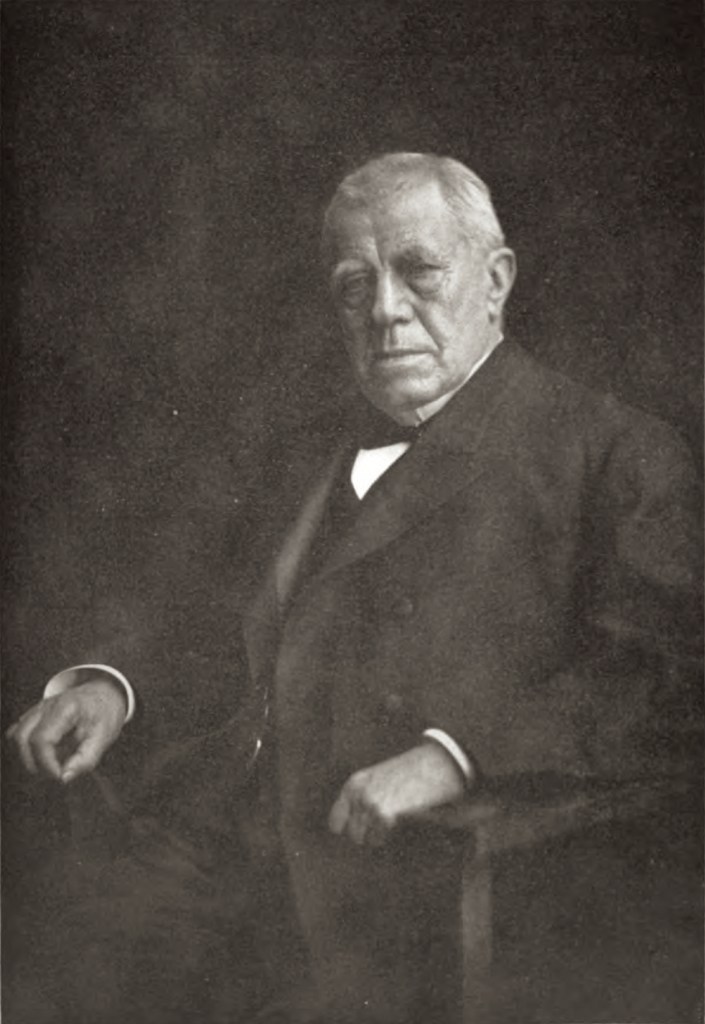
On this day in 1913, Dr. George Stöckhardt, professor of exegetical theology at Concordia Seminary in St. Louis, died. He had taught there since 1878 (full time after C.F.W. Walther’s death in 1887). He published books of sermons and commentaries on sections of Scripture. He is known as the greatest American Lutheran exegete and an excellent preacher. Here are a few items for you to learn more about his life and work.
I realized that I have managed to collect nearly all of his published works over the years (pictured below, plus two volumes that don’t have original covers). Two of these volumes are quite special to me.

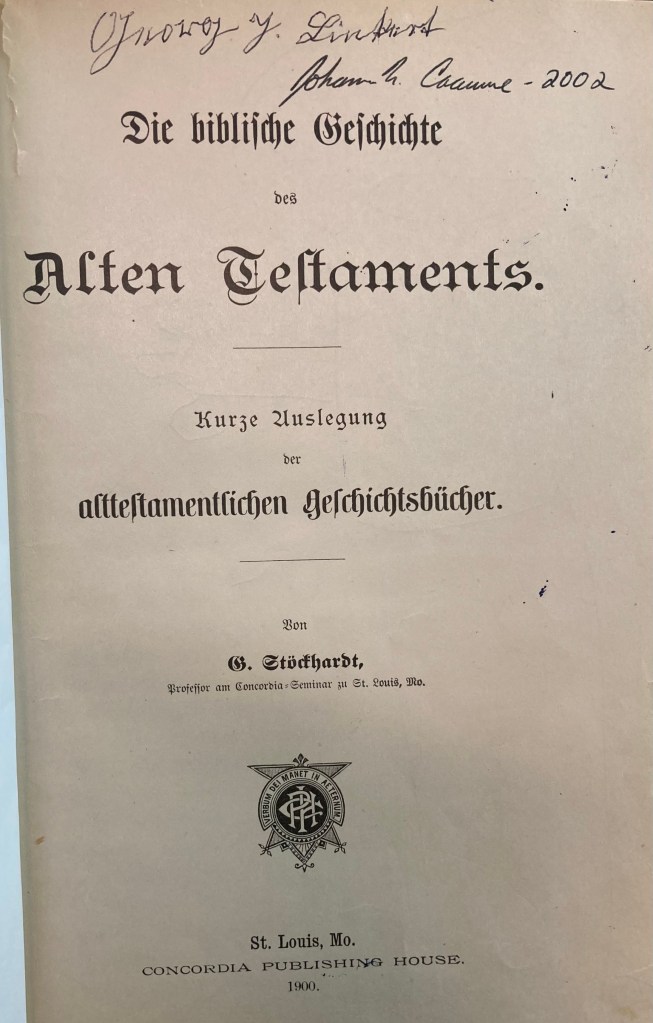
In 2002 I received a bunch of books from my great uncle, George Linkert, after he died. I didn’t know Uncle George really well, but I was able to sit at his hospice bedside the day before he died and sing hymns to him. The books I received included a German/Latin copy of the Book of Concord, a volume of Epistle sermons by CFW Walther, a music book that originally belonged to my great-great grandfather George Schindeldecker, and a copy of “The Bible History of the Old Testament” by George Stöckhardt. This book is a collection of brief commentaries on all the Bible stories of the Old Testament (460 of them!). The copy I got didn’t even have a cover on it anymore. So while I was at the Seminary I found a book binder in Milwaukee who rebound and put a new cover on it—nearly good as new!

I find them a very straight forward exposition of the facts of each story, along with brief applications to Christians of today. Yes, even though they were written over 125 years ago, it is amazing how timelessly the stories of the Bible apply to Christians of every age. Interestingly, I found that in multiple sections of the Paul Kretzmann’s Popular Commentary of the Bible (CPH, 1923), Kretzmann includes some applications that seem to be lifted word-for-word (in translation) out of Stöckhardt—without citation.

I have recently begun a project to put together a complete English edition of these Bible History volumes. I have posted some of the stories here as examples. It will take some time, but I’m hopeful that this will be useful to many students of the Scriptures.

The other volume I cherish is the collection of sermons based on the Gospels for the church year, called Gnade um Gnade, or “Grace upon Grace”. Back in college at MLC, we translated sermons from this book in the course “American Lutheran German Writings” with Professor Daniel Deutschlander. The sermons are quite brilliant. Fortunately, an English translation of this has been recently published. You can get it here (affiliate link). You can also listen to recordings of someone reading these translated sermons on the Gottesdienst Crowd podcast.

The copy I have was actually Professor Deutschlander’s copy, which he sent me with a very kind note after he had read through it one last time.

24 Years

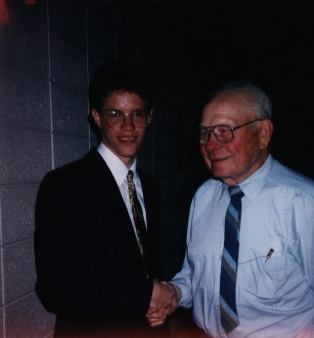
My feet hit the floor today on one of my Grandpa’s rag rugs that lies on the floor by my bed. I shaved with his double edge safety razor. When I got dressed, I put his slip-joint pocket knife into my pocket. It was twenty-four years ago today that my grandfather fell asleep in Jesus to await the resurrection of all flesh. It means a great deal to me that I can hold a tool in my hands that once served him and still functions just as well as it did in his hands.

But I am convinced that the most durable, well-crafted tools that have been passed through our generations are the hymns we have sung. I thought of him when we sang in church today:

Yea, Lord, ’twas thy rich bounty gave
my body, soul, and all I have
in this poor life of labor.
Lord, grant that I in ev’ry place
may glorify thy lavish grace
and help and serve my neighbor.
Let no false doctrine me beguile;
let Satan not my soul defile.
Give strength and patience unto me
to bear my cross and follow thee.
Lord Jesus Christ, my God and Lord, my God and Lord,
in death thy comfort still afford.

Lord, let at last thine angels come,
to Abr’ham’s bosom bear me home
that I may die unfearing;
and in its narrow chamber keep
my body safe in peaceful sleep
until thy reappearing.
And then from death awaken me
that these mine eyes with joy may see,
O Son of God, thy glorious face,
my Savior and my fount of grace.
Lord Jesus Christ, my prayer attend, my prayer attend,
and I will praise thee without end.

Woodcutter

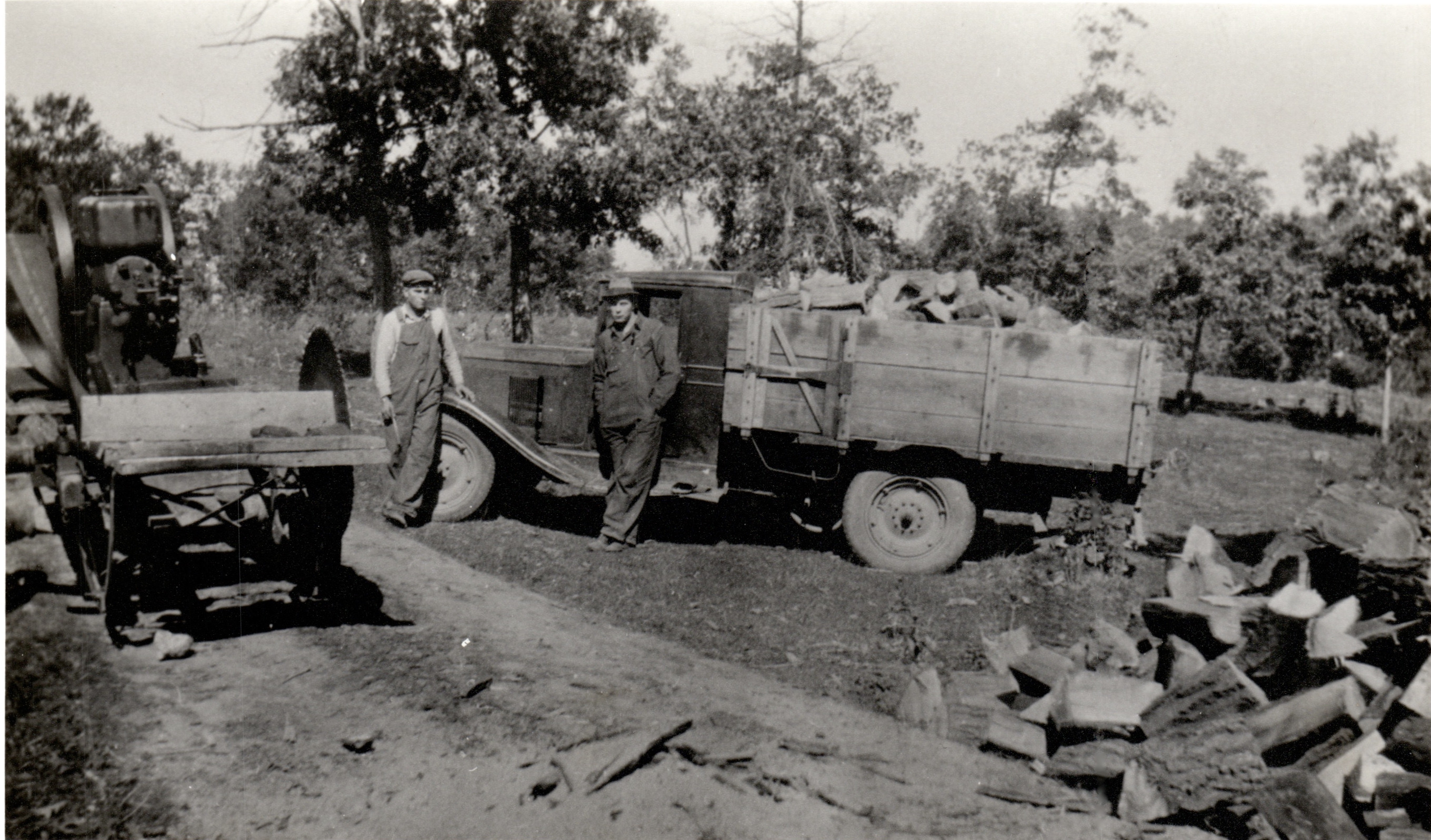
These are pictures of my grandfather cutting and hauling firewood. In the last few years, I have learned to love this same work, even though I don’t heat with wood and I no longer have access to the woods Grandpa owned and worked. I remember cutting wood with him. There was cutting, stacking, and carrying firewood into the house. But also the clearing of trees and brush later on, up to his last summer here. I distinctly recall him saying to one of his siblings on the phone about me, “Er kann die Chainsaw handeln” (He can handle the chainsaw). There is something uniquely satisfying about cutting wood. But there is something even more fulfilling to pick up some of the same worn-out tools and carry on the work begun by your fathers.

On the Passion of our Lord

Watch with your mind, brethren, that the mysteries of this season may not pass away without profit. The blessing is plentiful. Provide clean receptacles; display devout souls, watchful senses, sober emotions, and chaste consciences for such great gifts of grace. In good truth, not only does your confession of faith admonish you to take care in this matter, but it is the practice of the universal Church, whose sons you are. For all Christians cultivate holiness in observance of these sacred seven days, display modesty, pursue humility, put on gravity, either according to or beyond what is usual, that they may in some way seem to suffer with Christ’s suffering. For who is so impious as not to be sorrowful? Who so proud, as not to be humbled? Who so angry, as not to forgive? Who so luxurious, as not to abstain? Who so sensual, as not to practice self-restraint? Who so wicked, as not to repent during these days? And rightly so.

For the passion of the Lord is at hand, even now moving the earth, rending the rocks, and opening the tombs. Near also is His resurrection, in which you will celebrate a festival to the Most High, entering with enthusiasm and eagerness into the most glorious deeds which He has accomplished. Nothing better could be done in the world than that which was done by the Lord on these days. Nothing more useful or better could be recommended to the world, than that it should by perpetual ordinance celebrate year by year the memorial of these things with longing souls, and show forth the memory of His abundant sweetness…

Marvelous is Your passion, O Lord Jesus, which repelled the passions of all of us; made propitiation for our iniquities, and is found effectual for every one of our plagues. For what is there of death that is not destroyed by Your death?

–Bernard of Clairvaux, Sermon 24

Augustine on the Ministry

Unless the Lord helps us carry our burdens, we shall sink beneath them, and unless he carries us, we shall fall to our death. My position at your head frightens me, but the condition I share with you consoles me. I am a bishop set over you, but a Christian in company with you. The first is the name of the office I have undertaken, the second of grace; the first of danger, the second of salvation. So it is as if we are tossed about by a storm in the raging sea of that office, but as we remember who has redeemed us by his blood, it is as if we enter the safety of a harbor in the stillness of that thought. Though this office is hard work for us personally, the common benefit provides us with rest.

So if the fact that I have been redeemed with you delights me more than the fact that I have been set over you, then, as our Lord commands, I shall be more tirelessly your servant, for fear of being ungrateful for the redemption which made me worthy to be your fellow-servant.

–Ed. John E. Rotelle, “We Are Your Servants” Augustine’s Homilies on Ministry, (Villanova: Augustine Press, 1986), 155 pp. (HT: Harold Senkbeil, Doxology)

Das neue Regiment

In 1708, bwv71deckblattdruckJohann Sebastian Bach performed a
cantata at the annual inauguration of the new town council in Mühlhausen. It was entitled “Gott ist mein König” (God is my King).

It quotes a number of verses from Psalm 74, such as vs. 12: “Yet God my King is from of old, working salvation in the midst of the earth.”

And vs 16: “Yours is the day, yours also the night; you have established the heavenly lights and the sun. You have fixed all the boundaries of the earth.”

It closes with this prayer:

Das neue Regiment
Auf jeglichen Wegen
Bekröne mit Segen!
Friede, Ruh und Wohlergehen,
Müsse stets zur Seite stehen
Dem neuen Regiment.

Glück, Heil und großer Sieg
Muss täglich von neuen
Dich, Joseph, erfreuen,
Dass an allen Ort und Landen
Ganz beständig sei vorhanden
Glück, Heil und großer Sieg!

The new government
in every way
crown with blessing !
May peace, rest and prosperity
always stand by the side
of the new government.

Good fortune, salvation and great victory
must daily anew
delight you, Joseph,
so that in all lands and places
there may be continually by you
good fortune, salvation and great victory!

The Third Commandment

thirdcommandment

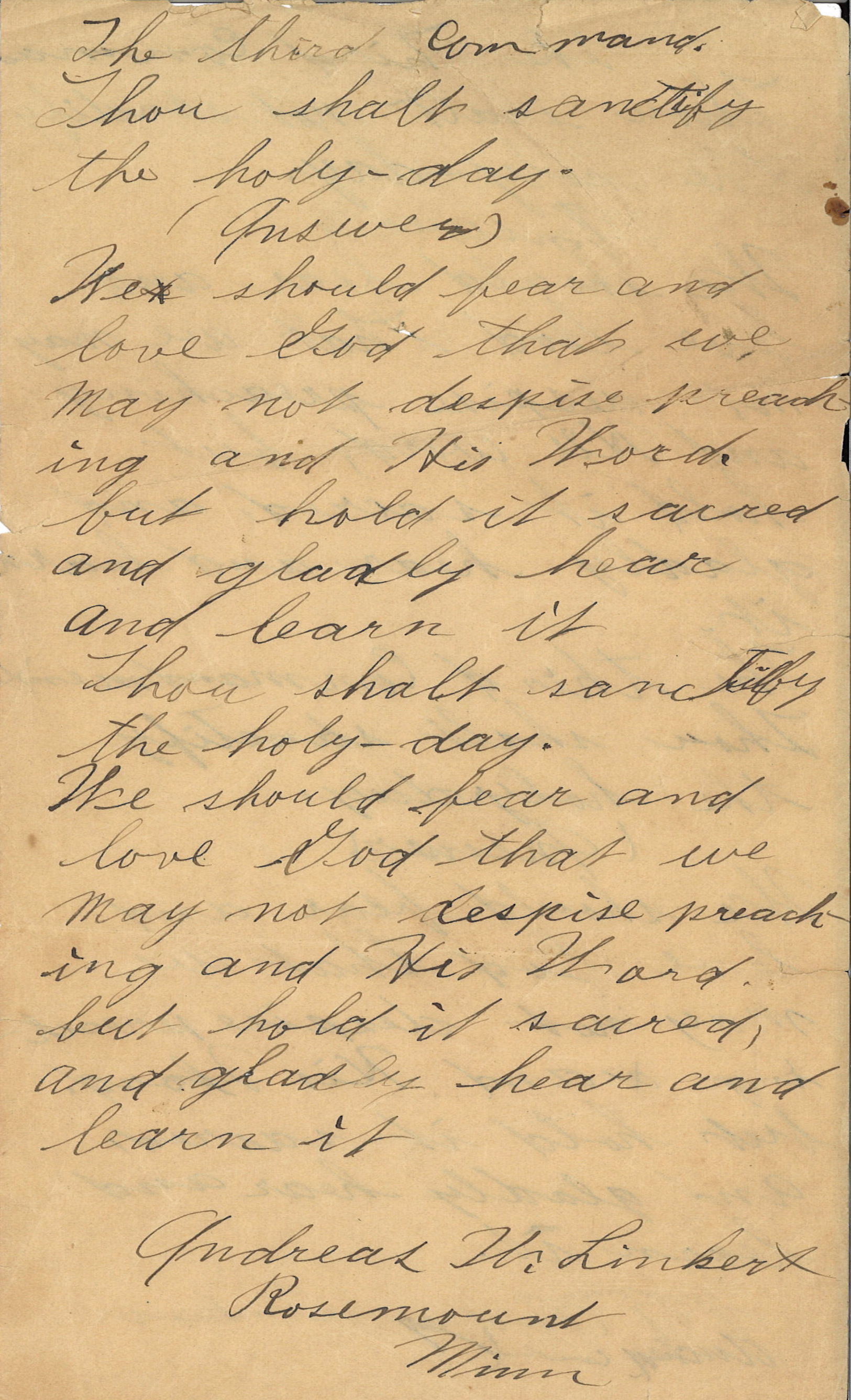
I just found this piece of paper in an old German book I have on my shelf. It appears to be some Catechism copywork by my grandfather. The Third Commandment is copied two more times on the back side of the sheet. I might have thought that this was during his Confirmation instruction days, except that I’m pretty sure he was confirmed in German. I wonder when he might have written this?